If you’ve ever tried growing figs in the UK, you’ll know the feeling… the tree grows beautifully, looks healthy all summer—and then autumn arrives before the fruit has a chance to ripen. That’s the real challenge here. It’s not growing figs. It’s getting them to ripen properly outdoors.
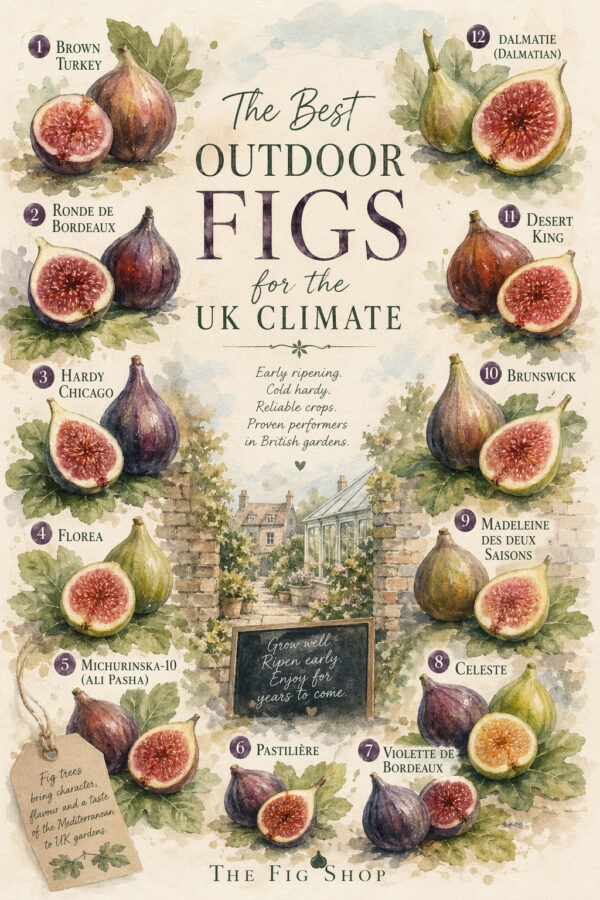
Over the years, after comparing nursery advice, grower experiences, and what actually works in British gardens, a pattern becomes very clear. Plenty of figs can grow here—but only a smaller group will reliably give you ripe fruit outside, year after year.
So what makes the difference?
The winners tend to share a few key traits:
they ripen early,
cope well with cold,
produce a dependable main crop,
and have proven themselves in cooler climates like ours.
Let’s walk through the ones that consistently come out on top—almost like we’re chatting over the garden fence.
So… which figs actually work?
1. Brown Turkey
Let’s start with the obvious one. If you’ve seen a fig tree in a UK garden, chances are it was Brown Turkey.
There’s a reason for that. It’s tough, forgiving, and usually delivers. The fruit is medium to large, with that classic sweet fig flavour most people expect. It ripens mid-season, so in a decent summer you’ll get a reliable crop.
If someone asked me, “Where do I start?”—this is still the safest answer.
2. Ronde de Bordeaux
Now this one is a bit of a star. Ronde de Bordeaux ripens very early, which is exactly what we need in the UK. Even in shorter summers, it often manages to produce a good crop of small to medium figs with a rich, berry-like flavour.
If your garden tends to run cool, this is one of the varieties that gives you real confidence.
3. Hardy Chicago
As the name suggests, this fig is built for colder conditions.
Hardy Chicago is one of those varieties that just gets on with it. It ripens early, handles winter well, and produces reliably outdoors. The figs are smaller, but the flavour—deep and berry-rich—more than makes up for it.
A great choice if you’re gardening in a colder or more exposed spot.
4. Florea
If earliness is everything, then Florea deserves attention.
This is one of the earliest figs around—often starting in early August—and it keeps going. It’s also incredibly hardy, tolerating temperatures far below what most UK winters throw at it.It’s not the showiest fig, but it’s one of the most dependable.
Especially useful further north.
5. Michurinska-10 (Ali Pasha)
This one is a bit of a workhorse.
Michurinska-10 is possibly one of the hardiest figs in the world. Hardiness (USDA) Zone 5 - 23 C.
It grows vigorously and can reache 5 m in height. Produces an abundance of small and tasty fruits.
It often produces two crops—a smaller early one and a main crop that starts around late July or early August and can carry on into autumn.
For UK growers, that long fruiting window can be a real advantage.
(PS Some regard Michurinska-10 as the same variety as Florea.)
6. Pastilière
Now we’re getting into flavour territory.
Pastilière produces medium-sized, dark figs with a rich berry taste. It ripens early enough to succeed in many UK gardens and tends to crop reliably. It’s one of those varieties that feels a bit more “special” once you’ve got the basics covered.
7. Violette de Bordeaux
A favourite among collectors—and for good reason.
Violette de Bordeaux produces small to medium figs with excellent flavour, and it grows in a naturally compact form. That makes it ideal if you’re short on space or growing in pots.
It does best in a sheltered spot, but given the right conditions, it performs very well.
8. Celeste
If you prefer a sweeter, honey-style fig rather than a berry flavour, Celeste is worth a look.
It’s hardy, dependable, and tends to produce well in the UK. The fruits are smaller, but very sweet, and it copes well with cooler conditions.
A classic variety that doesn’t get as much attention here as it probably should.
9. Madeleine des Deux Saisons
A traditional French variety with a bit of versatility.
Madeleine des Deux Saisons can produce both a breba crop and a main crop, which is always a bonus in the UK. It ripens early and has a delicate, sweet flavour.
Not always the heaviest cropper, but often a reliable one.
10. Brunswick
If you like big figs, this is the one people usually mention.
Brunswick produces large fruit and can do well in the UK—but it really prefers a warm, sheltered spot, ideally against a wall.
Give it the right conditions, and it rewards you well. In colder or exposed gardens, it can be a bit less consistent.
A couple worth mentioning…
It’s hard to stop at ten, because a few others are definitely worth knowing about.
Desert King is famous for its early breba crop—large, sweet figs that can ripen well ahead of the main season. In the right UK location, it can be excellent.
And Dalmatie (Dalmatian) produces very large, attractive figs with rich flavour. It’s better suited to warmer gardens, but when it works, it really shines.
Final thoughts
If there’s one takeaway from all this, it’s simple:
In the UK, success with figs is less about variety choice—and more about choosing the right variety.
Go for early ripening, proven performers, and cold-hardy types, and your chances improve dramatically.
Start with one or two reliable options like Ronde de Bordeaux or Brown Turkey, and build from there. Once you’ve seen a fig ripen properly in your own garden, it’s very hard to stop.
And if you’ve already got a fig tree that refuses to ripen… don’t give up just yet. You might just be one good variety away from success.